CivilAxisCivilAxis
☕ Support🌐 Community

SHS 220×220×10 - Section Properties

The SHS 220×220×10 is a steel section with a mass of 65.1 kg/m, an overall depth of 220 mm and width of 220 mm and a wall thickness of 10 mm. It has a cross-sectional area of 82.9 cm², a second moment of area Iᵧ of 6050 cm⁴, a plastic modulus Wₚₗ,ᵧ of 650 cm³, tabulated by CivilAxis from EN 10219 · Continental Steel.

Mass
65.1 kg/m
Depth
220 mm
Width
220 mm
Wall thickness
10 mm
Area
82.9 cm²
Ask about capacity, buckling or detailing for SHS 220×220×10.
🔍 Open the full Steel Catalogue
or pick a unit on any row
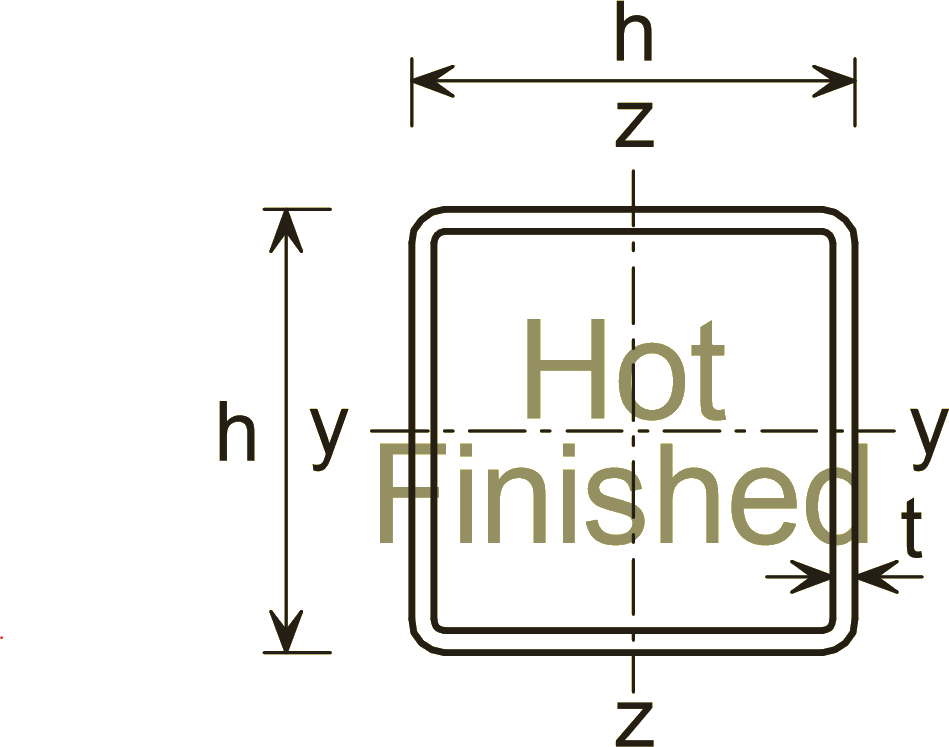
SHS section profile showing the dimension symbols used for SHS 220×220×10

Dimension symbols for SHS sections. Not to scale.

SHS 220×220×10 section properties to EN 10219 · Continental Steel.

Geometry

Depth of sectionh220
Width of sectionb220
Wall thicknesst10

Mass and area

Mass per metremass65.1
Cross-sectional areaA82.9

Bending about the major axis (y-y)

Area moment of inertia about y-axisIy6050
Elastic section modulus about y-axisWel,y550
Plastic section modulus about y-axisWpl,y650
Radius of gyration about y-axisiy8.54

Bending about the minor axis (z-z)

Area moment of inertia about z-axisIz6050
Elastic section modulus about z-axisWel,z550
Plastic section modulus about z-axisWpl,z650
Radius of gyration about z-axisiz8.54

Torsion and warping

Torsion constant (St Venant)It9473
Section modulus for torsionWt807

Surface area

Surface area per metreSA/m0.854

Is SHS 220×220×10 strong enough?

Simply supported beam, uniform load, major-axis bending - to EN 1993-1-1.

Passes - 61% utilised, deflection governs
Bending30%
68.3 / 230.8 kNm
Shear7%
60.8 / 849.6 kN
Deflection61%
7.6 / 12.5 mm

Class 1 section. ULS uses γQ = 1.5 on the load you enter; deflection uses the unfactored load against L/360. Lateral-torsional buckling is not included - the compression flange is assumed restrained.

Common questions about SHS 220×220×10

SHS 220×220×10 has a mass of 65.1 kg/m, tabulated to EN 10219. A 12 m length therefore weighs about 781 kg, which is the figure to use for a steel take-off or when checking a lift.

SHS 220×220×10 has a depth of 220 mm, a width of 220 mm, a wall thickness of 10 mm, with a cross-sectional area of 82.9 cm². These are the nominal dimensions from EN 10219; rolling tolerances apply to the delivered section.

The plastic section modulus about the major axis, Wpl,y, is 650 cm³, and the elastic modulus Wel,y is 550 cm³. Wpl,y is what sets the moment capacity of a Class 1 or 2 section: M_pl,Rd = Wpl,y x f_y / gamma_M0, so at S355 with gamma_M0 = 1.0 this section reaches about 231 kNm before any stability check.

The second moment of area about the major axis, Iy, is 6,050 cm⁴, and about the minor axis Iz is 6,050 cm⁴. Iy is the value deflection depends on - for a simply supported beam under a uniform load, the midspan deflection is 5wL⁴/384EIy - so on spans where a deflection limit governs rather than strength, this is the number that decides the section.

iy is 8.54 cm about the major axis and iz is 8.54 cm about the minor axis. Column buckling is governed by the SMALLER value: the slenderness is lambda = L_cr / i, so with iz = 8.54 cm a 0.9 m effective length already gives lambda = 100. Minor-axis buckling almost always controls unless the weak axis is restrained.

The St Venant torsion constant It is 9,473 cm⁴. Closed sections carry torsion in a shear flow around the perimeter, which makes them far stiffer in torsion than an open section of the same weight and is usually why one is specified.

Related SHS sizes

SHS 200×200×16SHS 220×220×5SHS 220×220×6SHS 220×220×8SHS 220×220×12SHS 220×220×14SHS 250×250×6SHS 250×250×6.3

Learn more

📘 How to read a steel section table (UB, UC, IPE, HE)📘 Section modulus explained: elastic (Wel) vs plastic (Wpl)📘 SHS vs RHS vs CHS: choosing a hollow steel section
All SHS sizes
Square Hollow Sections (SHS)
Full steel section tables
Every UB, UC, hollow, channel & angle section
Open the interactive tool
Search, compare & run EC3 capacity checks
Rate this
No ratings yet
Sign in to join the discussion.
Loading…