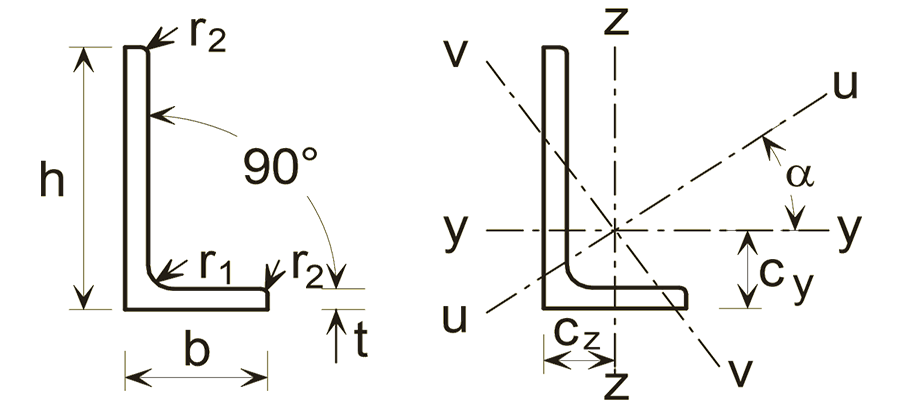
The UA 200×150×12 is a unequal angle with a mass of 32 kg/m, an overall depth of 200 mm and width of 150 mm. It has a cross-sectional area of 40.8 cm², a second moment of area Iᵧ of 1650 cm⁴, an elastic modulus Wₑₗ,ᵧ of 119 cm³, tabulated by CivilAxis from BS EN 1993-1-1:2005 / BS EN 10056-1:1999 (SCI P363 Blue Book).
Mass
32 kg/m
Depth
200 mm
Width
150 mm
Area
40.8 cm²
Ask about capacity, buckling or detailing for UA 200×150×12.
UA 200×150×12 section properties to BS EN 1993-1-1:2005 / BS EN 10056-1:1999.
Geometry
Depth of section
h
200
Width of section
b
150
Web thickness
tw
12
Flange thickness
tf
12
Root fillet radius
r
15
Toe radius
r2
7.5
Mass and area
Mass per metre
mass
32
Cross-sectional area
A
40.8
Bending about the major axis (y-y)
Area moment of inertia about y-axis
Iy
1650
Elastic section modulus about y-axis
Wel,y
119
Radius of gyration about y-axis
iy
6.36
Bending about the minor axis (z-z)
Area moment of inertia about z-axis
Iz
803
Elastic section modulus about z-axis
Wel,z
70.5
Radius of gyration about z-axis
iz
4.44
Principal axes
Area moment of inertia about u-u (major principal) axis
Iu
2030
Area moment of inertia about v-v (minor principal) axis
Iv
430
Radius of gyration about u-u axis
iu
7.04
Radius of gyration about v-v axis
iv
3.25
Elastic section modulus about u-u axis
Wel,u
119
Elastic section modulus about v-v axis
Wel,v
70.5
Torsion and warping
Torsion constant (St Venant)
It
20.9
Detailing dimensions
Centroid distance from back of leg (y)
cy
6.08
Centroid distance from back of leg (z)
cz
3.61
Common questions about UA 200×150×12
UA 200×150×12 has a mass of 32 kg/m, tabulated to BS EN 1993-1-1:2005 / BS EN 10056-1:1999. A 12 m length therefore weighs about 384 kg, which is the figure to use for a steel take-off or when checking a lift.
UA 200×150×12 has a depth of 200 mm, a width of 150 mm, a web thickness of 12 mm, a flange thickness of 12 mm, with a cross-sectional area of 40.8 cm². These are the nominal dimensions from BS EN 1993-1-1:2005 / BS EN 10056-1:1999; rolling tolerances apply to the delivered section.
The elastic section modulus about the major axis, Wel,y, is 119 cm³. Angles are tabulated about their principal (u-u and v-v) axes rather than a plastic major-axis modulus, so the elastic value is the one to design from unless you are working from the principal-axis properties directly.
The second moment of area about the major axis, Iy, is 1,650 cm⁴, and about the minor axis Iz is 803 cm⁴. Iy is the value deflection depends on - for a simply supported beam under a uniform load, the midspan deflection is 5wL⁴/384EIy - so on spans where a deflection limit governs rather than strength, this is the number that decides the section.
iy is 6.36 cm about the major axis and iz is 4.44 cm about the minor axis. Column buckling is governed by the SMALLER value: the slenderness is lambda = L_cr / i, so with iz = 4.44 cm a 0.4 m effective length already gives lambda = 100. Minor-axis buckling almost always controls unless the weak axis is restrained.
The St Venant torsion constant It is 20.9 cm⁴. Closed sections carry torsion in a shear flow around the perimeter, which makes them far stiffer in torsion than an open section of the same weight and is usually why one is specified.