CivilAxisCivilAxis
☕ Support🌐 Community

CF RHS 100×60×4 - Section Properties

The CF RHS 100×60×4 is a rectangular hollow section with a mass of 9.22 kg/m, an overall depth of 100 mm and width of 60 mm and a wall thickness of 4 mm. It has a cross-sectional area of 11.7 cm², a second moment of area Iᵧ of 153 cm⁴, a plastic modulus Wₚₗ,ᵧ of 37.9 cm³, tabulated by CivilAxis from BS EN 10219-2:2006 (SCI P363 Blue Book).

Mass
9.22 kg/m
Depth
100 mm
Width
60 mm
Wall thickness
4 mm
Area
11.7 cm²
Ask about capacity, buckling or detailing for CF RHS 100×60×4.
🔍 Open the full Steel Catalogue📖 Design theory📐 Worked example
or pick a unit on any row
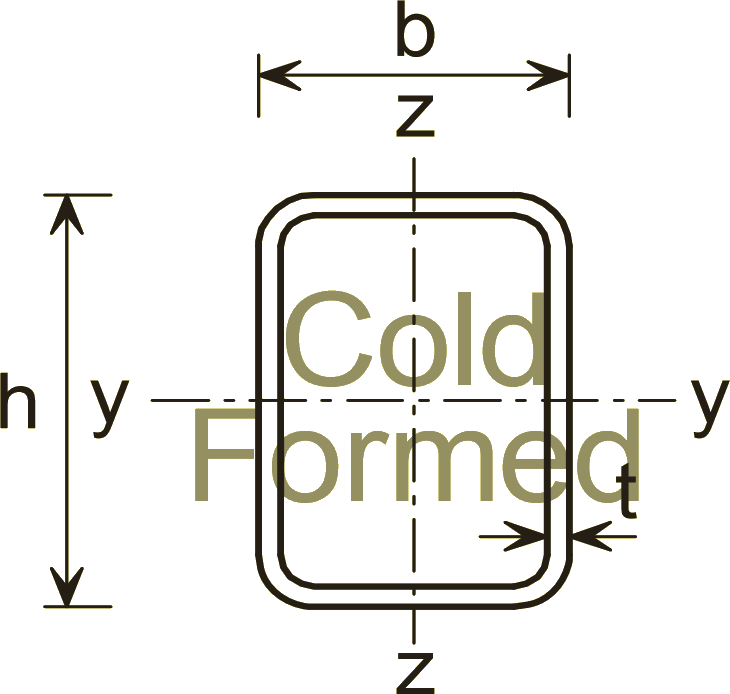
RHS Cold-formed section profile showing the dimension symbols used for CF RHS 100×60×4

Dimension symbols for RHS Cold-formed sections. Not to scale.

CF RHS 100×60×4 section properties to BS EN 10219-2:2006.

Geometry

Depth of sectionh100
Width of sectionb60
Wall thicknesst4

Mass and area

Mass per metremass9.22
Cross-sectional areaA11.7

Bending about the major axis (y-y)

Area moment of inertia about y-axisIy153
Elastic section modulus about y-axisWel,y30.5
Plastic section modulus about y-axisWpl,y37.9
Radius of gyration about y-axisiy3.6

Bending about the minor axis (z-z)

Area moment of inertia about z-axisIz68.7
Elastic section modulus about z-axisWel,z22.9
Plastic section modulus about z-axisWpl,z26.6
Radius of gyration about z-axisiz2.42

Torsion and warping

Torsion constant (St Venant)It156
Section modulus for torsionWt38.7

Classification and stability

Flange local-buckling ratiocf/tf12
Web local-buckling ratiocw/tw22

Surface area

Surface area per metreSA/m0.306
Surface area per tonneSA/t33m²/t

Is CF RHS 100×60×4 strong enough?

Simply supported beam, uniform load, major-axis bending - to EN 1993-1-1.

Passes - 58% utilised, deflection governs
Bending28%
3.8 / 13.5 kNm
Shear5%
7.5 / 149.9 kN
Deflection58%
3.2 / 5.6 mm

Class 1 section. ULS uses γQ = 1.5 on the load you enter; deflection uses the unfactored load against L/360. Lateral-torsional buckling is not included - the compression flange is assumed restrained.

Common questions about CF RHS 100×60×4

CF RHS 100×60×4 has a mass of 9.22 kg/m, tabulated to BS EN 10219-2:2006. A 12 m length therefore weighs about 111 kg, which is the figure to use for a steel take-off or when checking a lift.

CF RHS 100×60×4 has a depth of 100 mm, a width of 60 mm, a wall thickness of 4 mm, with a cross-sectional area of 11.7 cm². These are the nominal dimensions from BS EN 10219-2:2006; rolling tolerances apply to the delivered section.

The plastic section modulus about the major axis, Wpl,y, is 37.9 cm³, and the elastic modulus Wel,y is 30.5 cm³. Wpl,y is what sets the moment capacity of a Class 1 or 2 section: M_pl,Rd = Wpl,y x f_y / gamma_M0, so at S355 with gamma_M0 = 1.0 this section reaches about 13 kNm before any stability check.

The second moment of area about the major axis, Iy, is 153 cm⁴, and about the minor axis Iz is 68.7 cm⁴. Iy is the value deflection depends on - for a simply supported beam under a uniform load, the midspan deflection is 5wL⁴/384EIy - so on spans where a deflection limit governs rather than strength, this is the number that decides the section.

Its local-buckling ratios are cf/tf = 12 for the flange and cw/tw = 22 for the web. EN 1993-1-1 Table 5.2 compares these against limits scaled by epsilon = sqrt(235/f_y), so the class depends on the steel grade as well as the geometry - the same section can be Class 1 in S275 and Class 3 in S355. Use the Capacity tab on this page for the classification at a specific grade.

iy is 3.6 cm about the major axis and iz is 2.42 cm about the minor axis. Column buckling is governed by the SMALLER value: the slenderness is lambda = L_cr / i, so with iz = 2.42 cm a 0.2 m effective length already gives lambda = 100. Minor-axis buckling almost always controls unless the weak axis is restrained.

The St Venant torsion constant It is 156 cm⁴. Closed sections carry torsion in a shear flow around the perimeter, which makes them far stiffer in torsion than an open section of the same weight and is usually why one is specified.

Related RHS Cold-formed sizes

CF RHS 100×50×5CF RHS 100×50×6CF RHS 100×60×3CF RHS 100×60×3.5CF RHS 100×60×5CF RHS 100×60×6CF RHS 100×80×3CF RHS 100×80×4

Compare with other sections

Side-by-side properties against the closest equivalent in each catalogue.

vs RHS 100×60×4

Learn more

📘 How to read a steel section table (UB, UC, IPE, HE)📘 Section modulus explained: elastic (Wel) vs plastic (Wpl)📘 SHS vs RHS vs CHS: choosing a hollow steel section
All RHS Cold-formed sizes
Rectangular Hollow Sections - Cold-formed (BS EN 10219)
Full steel section tables
Every UB, UC, hollow, channel & angle section
Open the interactive tool
Search, compare & run EC3 capacity checks
Rate this
No ratings yet
Sign in to join the discussion.
Loading…