
Pile Capacity from SPT to TCVN 10304

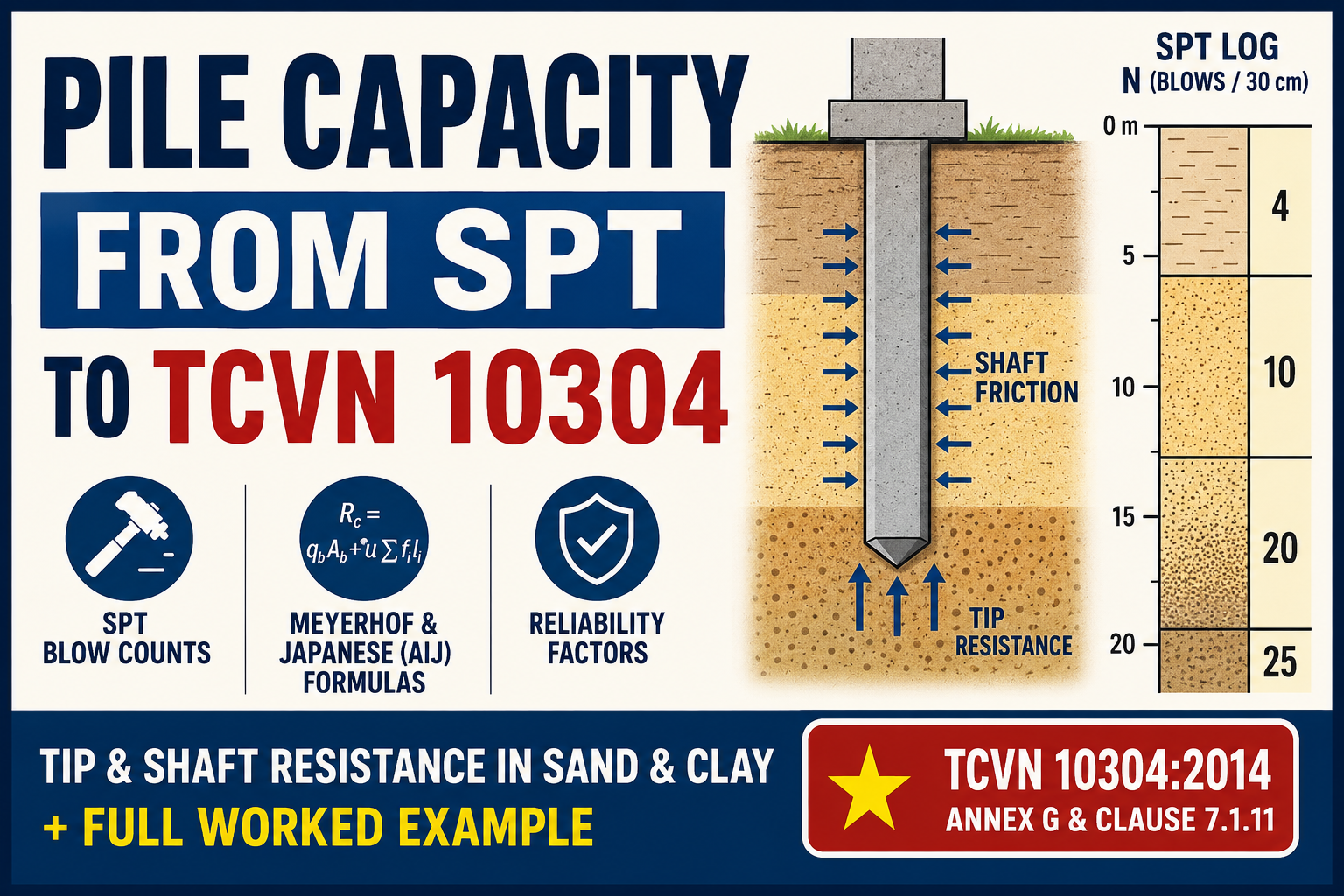
What this check does
The bearing capacity of a single pile from soil strength is the sum of tip resistance and shaft friction:
where:
- ultimate compressive capacity of the pile (kN)
- unit tip (base) resistance (kPa)
- pile tip cross-section area (m^2)
- pile perimeter (m)
- unit shaft friction in soil layer (kPa)
- pile length within layer (m)
TCVN 10304:2014 Annex G estimates and directly from SPT blow counts - the test every Vietnamese soil investigation already has. Two formulas are given: the Meyerhof formula and the Japanese (AIJ) formula. The result is then divided by reliability factors (clause 7.1.11) to get the design value, and the pile's own structural capacity is checked separately - the smaller of the two governs.
Method 1 - the Meyerhof formula (Annex G.3.1)
where:
- SPT blow count near the pile tip (-)
- average SPT blow count along the shaft (-)
- pile length in the ground (m)
- tip coefficient: 400 for driven piles, 120 for bored piles (kPa)
- shaft coefficient: 2.0 for driven piles, 1.0 for bored piles (kPa)
This is the classic Meyerhof (1976) proposal: displacement piles mobilise roughly twice the shaft friction of bored piles, and their tip resistance benefits from the soil densified by driving. Behind the tip coefficient sits Meyerhof's cap (kPa) - for normal embedment ratios the cap governs, which is where comes from.
Method 2 - the Japanese (AIJ) formula (Annex G.3.2)
The formula Vietnamese practice uses most, because it treats sand and clay layers separately:
Tip resistance (sand at the tip):
Pile type | |
|---|---|
Driven / jacked | (kPa) |
Bored | (kPa) |
with averaged over the zone from about below to above the tip. For a clay tip use (driven) or (bored) instead.
Shaft friction, sand layers:
Shaft friction, clay layers:
where:
, - SPT counts in sand / clay layer (-)
- undrained shear strength of clay layer (kPa)
- adhesion factor: 1.0 for driven piles; for bored piles from the code's chart (falls below 1.0 as grows)
- flexibility factor for long slender piles (1.0 for rigid piles)
From ultimate to design value (clause 7.1.11)
where:
- working-condition factor: 1.0 for a single pile, 1.15 for piles in a group
- importance factor: 1.1 to 1.2 by importance level of the structure
- reliability factor on the capacity: 1.4 when comes from calculation (including the SPT formulas); lower values are allowed when static load tests are performed
An SPT-based capacity is an estimate for sizing - on any real project the code expects verification by static load test (thu tinh), and the pile's structural (material) capacity must be checked as a separate limit.
Worked example - driven pile 350 x 350, L = 20 m (Japanese formula)
Pile: driven RC pile, mm, m. m^2, m.
Soil profile (SPT):
Depth (m) | Soil | Unit friction | |
|---|---|---|---|
0 - 8 | soft clay | 4 | kPa, kPa |
8 - 16 | medium sand | 10 | kPa |
16 - 20 | dense sand | 20 | kPa |
tip (20) | dense sand | - |
Tip resistance:
Shaft resistance:
Ultimate capacity:
Design value (group of piles , importance level II , capacity by calculation ):
Result: the soil gives a design capacity of about 1390 kN per pile. Note the split: the shaft carries 53% and the tip 47% - and the soft clay contributes only 19% of the shaft total despite being 40% of the length. The pile's structural capacity (concrete grade, reinforcement, driving stresses) must be checked separately and often governs for slender driven piles.
Key points
Annex G is two formulas, not one: Meyerhof () and the Japanese formula (sand and clay layers treated separately) - run both when the log allows and compare.
Driven piles get roughly twice the unit resistances of bored piles in the Meyerhof coefficients - displacement matters.
The reliability chain takes the ultimate value down by about 1.4-1.7; do not quote an Annex G number as a working load without it.
SPT capacity is a sizing estimate; static load tests confirm it, and the material capacity of the pile section is a separate check that can govern.
Watch the layer bookkeeping: unit frictions apply per layer over the length actually in that layer - the single most common spreadsheet error in this calculation.
References
- TCVN 10304:2014 - Móng cọc - Tiêu chuẩn thiết kế, Phụ lục G và mục 7.1.11
- Meyerhof, G.G. (1976) - Bearing capacity and settlement of pile foundations, ASCE JGED
- AIJ - Recommendations for design of building foundations (basis of the Japanese formula)