
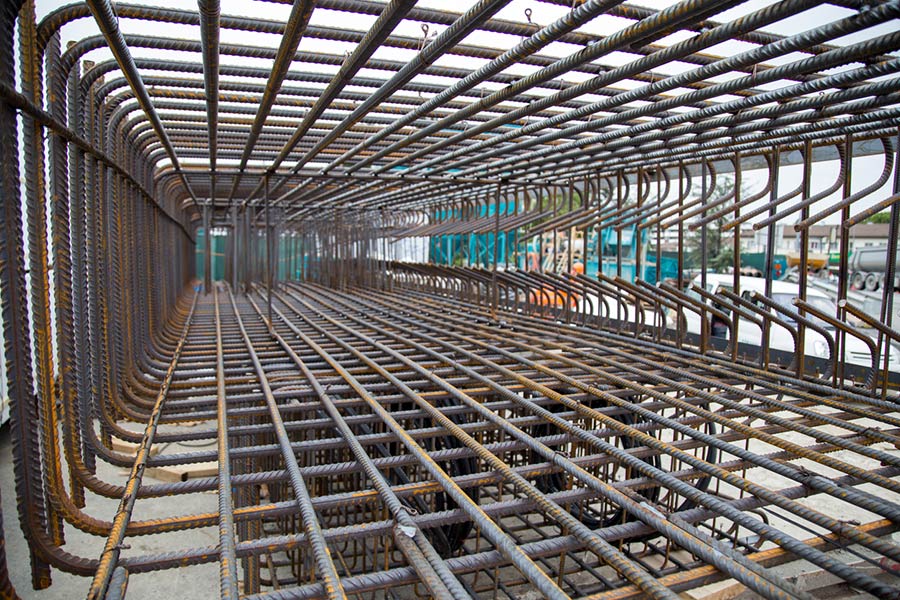
A beam with a small bending moment needs very little steel for strength. The flexural check will happily return an area of reinforcement that is tiny. The problem is what happens when the concrete cracks.
The failure the rule prevents
Before cracking, the concrete in the tension zone carries the tensile force. At the cracking moment that force is released almost instantly, and it has to go somewhere. If the reinforcement cannot take it, the steel yields straight away and the beam fails with little warning. The rule for minimum steel exists to make sure the bars can carry the force the concrete gives up when it cracks.
That is why the rule is written in terms of the concrete tensile strength, not the applied load.
The EC2 expression
EN 1992-1-1 §9.2.1.1 gives the minimum area of longitudinal tension reinforcement as:
where is the mean width of the tension zone and is the effective depth. The same clause caps the steel outside lap locations at .
Stronger concrete needs more minimum steel
Because grows with the concrete class, the minimum ratio grows too. With MPa:
Class | (MPa) | Governing ratio | |
|---|---|---|---|
C20/25 | 2.2 | 0.00114 | 0.00130 |
C25/30 | 2.6 | 0.00135 | 0.00135 |
C30/37 | 2.9 | 0.00151 | 0.00151 |
C40/50 | 3.5 | 0.00182 | 0.00182 |
This surprises people. Specifying a higher class "to be safe" raises the cracking force, so it also raises the steel needed to catch it. Below about C25/30 the fixed floor of 0.0013 governs.
A quick example
A 300 x 600 mm beam in C30/37 with mm:
Two 12 mm bars give 226 mm², which fails the rule even if the moment check only asked for 150 mm². Two 16 mm bars give 402 mm² and pass. The upper limit is far away: mm².
Not the same as crack control steel
EC2 has a second, separate minimum in §7.3.2 for controlling cracks from restraint, such as shrinkage in a wall held at its base. That one uses the tension zone area and a permitted steel stress. A beam can satisfy §9.2.1.1 and still need more steel for §7.3.2, so check both where restraint matters.
Takeaways
Minimum steel is about the cracking force, not the design moment.
The ratio rises with concrete class; from C25/30 upward the term governs.
Check it on every lightly loaded member, because that is exactly where it bites.
Crack control minimum steel (§7.3.2) is a different check.
#eurocode2 #detailing