 Nhi Nguyễn Lương Khánh
When One Bridge Pier Fails: What Really Caused the Collapse of the Francis Scott Key Bridge?
CivilAxis Research Review #001
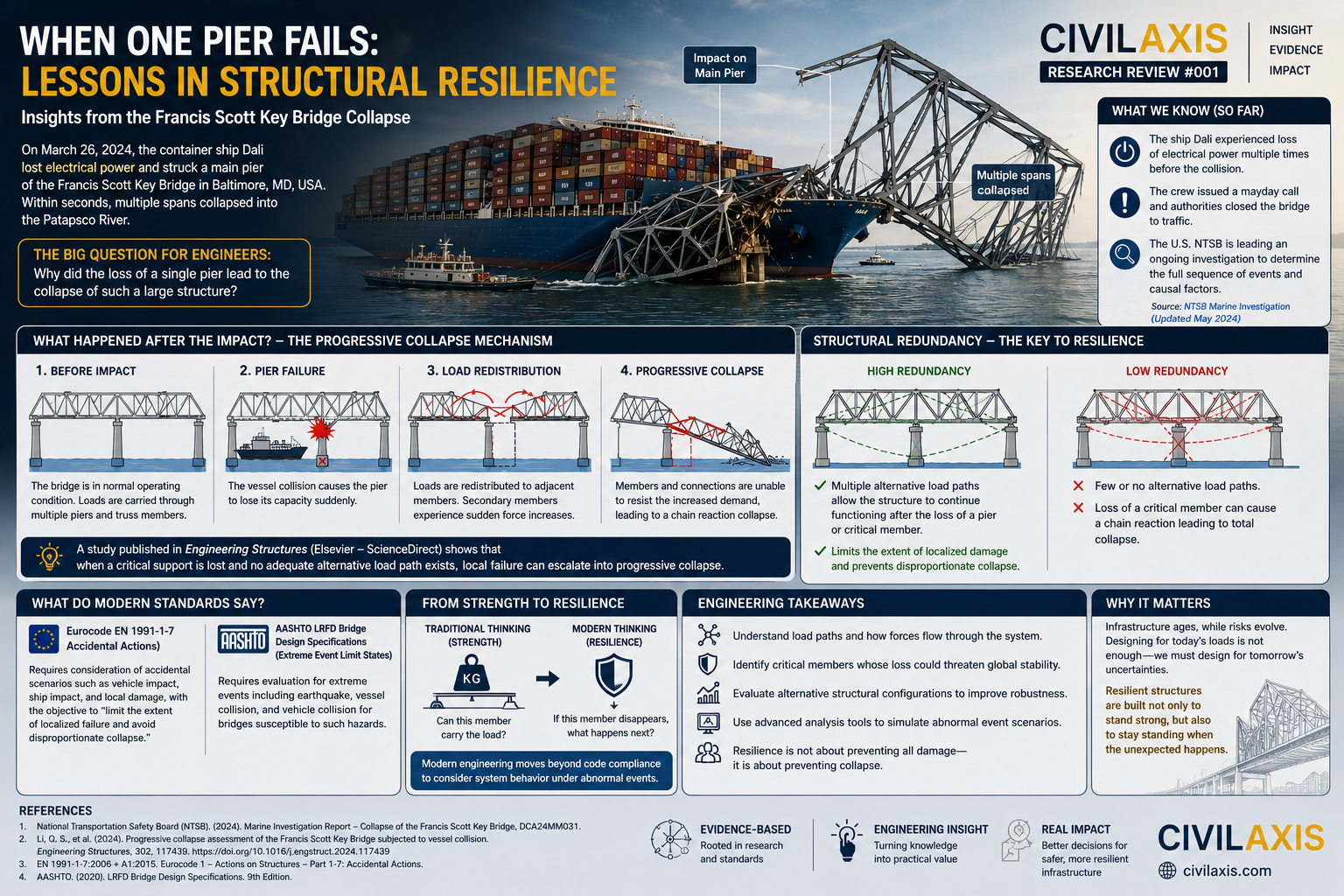
On March 26, 2024, the Francis Scott Key Bridge in Baltimore, Maryland, collapsed within seconds after the container ship Dali struck one of its primary support piers.
For the general public, it was a tragic maritime accident.
For structural engineers, however, it quickly became an engineering question that demanded answers.
After all, vessel collisions with bridges are not unprecedented. What made this incident extraordinary was not merely the impact itself, but the scale of the structural failure. The loss of a single bridge pier triggered the collapse of multiple spans in a matter of seconds.
What actually happened inside the structural system?
To answer that question, we must first examine what has been confirmed by the official investigation.
What We Know So Far
According to the U.S. National Transportation Safety Board (NTSB), the container ship Dali experienced multiple electrical blackouts before the collision, resulting in a loss of propulsion and steering control. The crew successfully issued a mayday call shortly before impact, allowing authorities to halt traffic on the bridge and significantly reduce potential casualties.
While the investigation is still ongoing, these findings explain why the collision occurred.
They do not, however, explain why the bridge collapsed so rapidly after the impact.
It is precisely this unanswered question that has become the focus of numerous engineering studies following the incident.
What Are Researchers Investigating?
In the aftermath of the collapse, several research groups began using numerical simulations to reconstruct the bridge’s structural response.
Rather than determining legal responsibility, studies published in journals such as Engineering Structures (Elsevier - ScienceDirect) have focused on a more fundamental engineering question:
What happens to a structural system when a critical support suddenly disappears?
Their analyses suggest that once a primary pier loses its load-carrying capacity, the structure must immediately redistribute its internal forces to the remaining members.
If sufficient alternative load paths do not exist, this sudden redistribution can overload adjacent members, allowing localized damage to propagate into a progressive collapse.
In other words, these studies shift the discussion away from the strength of individual members and toward the behaviour of the entire structural system when subjected to an abnormal event.
And that brings us to one of the most important concepts in modern structural engineering: Structural redundancy.
Structural Redundancy - Why Does It Matter?
In structural engineering, structural redundancy describes a system’s ability to continue functioning even after one or more critical components have failed.
When multiple load paths are available, internal forces can be redistributed throughout the structure, limiting the extent of localized damage.
Conversely, if the structure relies heavily on only a few critical members, the loss of one of them may compromise the stability of the entire system.
This is far from a new concept.
For decades, research on progressive collapse has consistently shown that a structure’s resilience depends not only on the strength of its individual members, but also on the availability of redundant load paths that allow the system to adapt after unexpected damage.
This naturally raises another question:
Have these principles already been incorporated into modern design standards?
What Do Modern Design Standards Say?
The answer is yes.
Eurocode EN 1991-1-7 - Actions on Structures: Accidental Actions requires engineers to consider accidental scenarios such as vessel impact, vehicle collision, and localized structural damage. Its objective is not to eliminate every possible failure, but to limit the extent of localized damage and avoid disproportionate collapse.
Similarly, the AASHTO LRFD Bridge Design Specifications define Extreme Event Limit States, requiring bridge designers to evaluate hazards such as earthquakes, vehicle collisions, and vessel impacts where applicable.
Together, these standards reflect an important evolution in engineering philosophy.
Instead of asking only,
“Can this structure safely carry its design loads?”
modern design also asks,
“If localized damage occurs, can the structure prevent that damage from spreading?”
This shift forms the foundation of today’s concepts of structural robustness and resilience.
From Research to Engineering Practice
For practicing engineers, these lessons do not imply that every bridge should be designed to withstand every conceivable extreme event. Such an approach would be technically and economically impractical.
Instead, the key is to understand how the structural system behaves, identify its critical members, and evaluate how loads are redistributed when unexpected failures occur.
This is also why modern structural analysis tools increasingly support evaluations of:
Alternative load paths
Critical members
System behaviour
Structural robustness
alongside conventional checks for stress, deflection, and code compliance.
The objective is no longer limited to verifying whether a structure is strong enough-it is also to understand how it will behave when reality exceeds design assumptions.
The CivilAxis Perspective
Every major engineering failure leaves behind lessons that extend far beyond the incident itself.
The collapse of the Francis Scott Key Bridge reminds us that a bridge is more than a collection of beams, columns, and connections.
It is an integrated structural system, where every component contributes to how forces are transferred-and ultimately, how the entire structure responds when one of those components is lost.
As research continues to advance and modern design standards increasingly emphasize robustness and resilience alongside traditional strength-based design, understanding system-level behaviour will become an essential competency for structural engineers.
Perhaps, then, the most important question raised by this tragedy is not:
“Why did that bridge collapse?”
But rather:
“If a critical component in the structure I’m designing were suddenly removed, what would happen next?”
That question may ultimately define the future of resilient infrastructure design.