
 Minh Tran
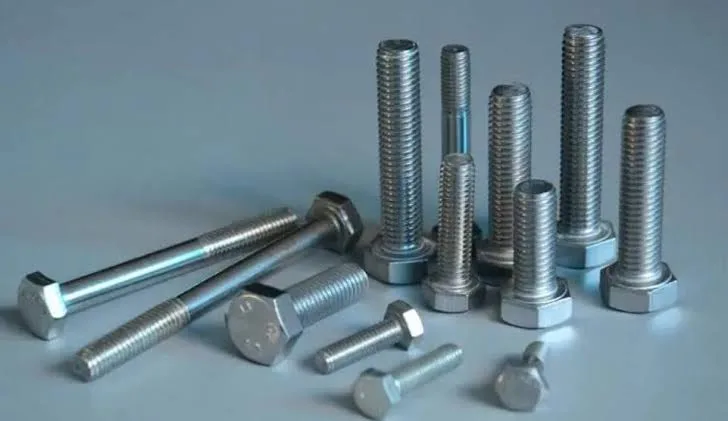
Pick up a structural bolt and the head is stamped with something like 8.8 or 10.9. Most engineers know that the second is stronger. Fewer can say what either digit actually means, which matters because one of them silently changes a factor in the shear resistance formula.
The two digits
The designation comes from EN ISO 898-1 and is arithmetic, not a catalogue number.
The first number, multiplied by 100, is the nominal ultimate tensile strength in MPa.
The product of both numbers, multiplied by 10, is the nominal yield strength in MPa. Equivalently, the second digit divided by 10 is the yield-to-ultimate ratio.
So an 8.8 bolt has MPa and MPa. A 10.9 bolt has 1000 MPa and 900 MPa. A 4.6 bolt, the ordinary black bolt, has 400 MPa and 240 MPa.
EN 1993-1-8 Table 3.1 lists the grades the code recognises:
Grade | (MPa) | (MPa) |
|---|---|---|
4.6 | 240 | 400 |
4.8 | 320 | 400 |
5.6 | 300 | 500 |
5.8 | 400 | 500 |
6.8 | 480 | 600 |
8.8 | 640 | 800 |
10.9 | 900 | 1000 |
Notice that the yield ratio rises as you go down the table. A 4.6 bolt yields at 60% of its ultimate strength and has a long plastic plateau. A 10.9 bolt yields at 90% of its ultimate and has very little warning left between the two.
Where the ratio changes a formula
That yield ratio is not just descriptive. It is the reason the shear resistance factor is not constant.
With the shear plane passing through the threaded part, EN 1993-1-8 Table 3.4 gives for grades 4.6, 5.6 and 8.8, and for grades 4.8, 5.8, 6.8 and 10.9. The split follows the yield ratio exactly: the grades with a second digit of 6 keep 0.6, and the ones with 8 or 9 drop to 0.5.
The physical reason is ductility. A bolt in shear relies on being able to deform and share load with its neighbours in the group. A high yield ratio means less plastic capacity before fracture, so the code takes a larger margin.
The consequence is easy to miss in a quick comparison. Going from 8.8 to 10.9 raises by 25% but drops from 0.6 to 0.5, a reduction of 17%. The net gain in shear resistance through the threads is only about 4%. If you upgraded a connection from 8.8 to 10.9 expecting a quarter more shear capacity, you got almost nothing.
Tension is different. There is no in
with for an ordinary bolt and 0.63 for a countersunk one, so the full 25% comes through. 10.9 buys you tension, not shear.
Preloaded and slip-resistant connections
Only grades 8.8 and 10.9 may be preloaded. The preload is defined as
and a slip-resistant connection carries load by friction between the plies rather than by bearing on the bolt shank. That is why the surface preparation class matters so much: the slip factor runs from 0.2 for an untreated surface to 0.5 for a blasted Class A surface, and it multiplies directly into the resistance.
This is the one place where 10.9 pays off clearly. Preload is proportional to , so a 10.9 bolt delivers 25% more clamping force than the same 8.8 bolt, and therefore 25% more slip resistance. Category B and C connections, and anything carrying load reversal or fatigue, are where the grade earns its cost.
Practical points that are not in the formulae
Shear plane position. If the shear plane passes through the unthreaded shank, for every grade and the gross area replaces . That is a real gain, but it depends on grip length and washer thickness and it can be undone on site by a longer bolt than the drawing assumed. Most designers do not rely on it.
Hydrogen embrittlement. High-strength bolts, especially 10.9, are sensitive to hydrogen introduced during galvanising. The coating process has to be specified correctly, and that is a procurement question rather than a calculation.
Tightening. A preloaded bolt is only preloaded if it was tightened by a controlled method: torque, combined, HRC or direct tension indicator. A 10.9 bolt pulled up with a podger spanner is an expensive 10.9 bolt in a bearing-type connection.
Mixing grades. Do not put 8.8 and 10.9 bolts in the same group. They look similar, they are not interchangeable on site, and the stiffer bolt attracts load first.
Takeaways
First digit times 100 is ; the two digits multiplied by 10 give .
The second digit is the yield ratio, and it decides : 0.6 when it is 6, 0.5 when it is 8 or 9.
Upgrading 8.8 to 10.9 gains about 4% in shear through the threads, but a full 25% in tension and in preload.
Only 8.8 and 10.9 may be preloaded; slip resistance is where 10.9 genuinely pays.
Specify the tightening method and the coating process, or the grade on the head means less than it should.
#eurocode3 #boltedconnections #steeldesign