
RC Beam Flexure Design to TCVN 5574:2018
How TCVN 5574:2018 checks the ultimate bending capacity of a rectangular reinforced-concrete section - the rectangular stress block, the relative compression-zone height, the ductility limit (relative boundary height), and singly vs doubly reinforced sections - with a worked example.

What this check does
For a beam under bending, TCVN 5574:2018 (clause 8.1.2) checks that the design bending moment does not exceed the section bending capacity :
Unlike Eurocode 2, TCVN 5574 tabulates the design strengths directly - the concrete design strength and the steel design strengths (tension) and (compression) already contain the material safety factors. You look them up in a table and use them as-is; there is no separate / division at the point of use.
The rectangular stress block
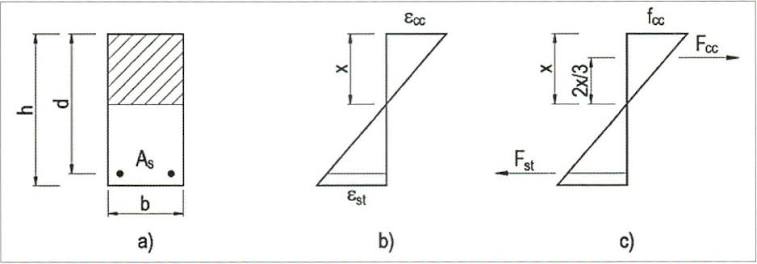
The method assumes a rectangular compression stress block: the concrete carries its full design strength uniformly over a compression depth (measured from the compression face), and the tension steel carries .
For a singly reinforced section, horizontal (axial) equilibrium in pure bending gives the compression-zone depth:
where:
- concrete design compressive strength (MPa), from the grade table
- section width (mm)
- steel design tensile strength (MPa)
- area of tension reinforcement (mm^2)
- depth of the rectangular compression zone (mm)
The moment capacity is then taken about the tension steel:
with the effective depth , where is the overall depth and the distance from the tension face to the centroid of the tension steel.
The ductility limit - relative boundary height
A section is safe in bending only if the tension steel yields before the concrete crushes (a ductile failure). TCVN 5574 controls this with the relative compression-zone height and the relative boundary height (clause 8.1.2.2.3):
where:
- relative boundary height (the value of at which steel yielding and concrete crushing occur simultaneously)
- the elastic yield strain of the steel
- steel modulus of elasticity (MPa)
- the ultimate concrete compressive strain (heavy concrete)
The rule is:
If the section is under-reinforced - the tension steel yields first, the failure is ductile, and the capacity above is valid.
If the section is over-reinforced - the concrete crushes first (brittle). The usable capacity is capped at the boundary depth , and you should add compression steel or enlarge the section rather than rely on the extra tension steel.
Doubly reinforced sections
When compression steel (area, at distance from the compression face) is present and active, it enters both equilibrium and the moment:
where is the steel design compressive strength and the cover to the compression steel. If the resulting is very small () the compression steel is not effective in compression and the section is treated as singly reinforced.
Design strengths (TCVN 5574:2018 tables)
Representative ULS design strengths used below:
Concrete grade | (MPa) | (MPa) |
|---|---|---|
B20 | 11.5 | 0.90 |
B25 | 14.5 | 1.05 |
B30 | 17.0 | 1.20 |
Rebar grade | (MPa) | (MPa) | (MPa) |
|---|---|---|---|
CB300-V | 260 | 260 | 210000 |
CB400-V | 350 | 350 | 200000 |
CB500-V | 435 | 435 | 200000 |
Worked example
Section: mm, mm, mm, concrete B25, tension steel CB400-V, mm^2 (about 3 x phi 25), singly reinforced. Design moment kN.m.
Design strengths: MPa, MPa, MPa.
Effective depth:
Relative boundary height:
Compression-zone depth:
Moment capacity:
Result: kN.m - the section passes in flexure, with the steel yielding first (ductile). The utilisation is close to 1.0, so there is little spare capacity.
Key points
TCVN 5574 uses tabulated design strengths - no separate material-factor division at use.
Bending capacity comes from the rectangular stress block: find from equilibrium, take the moment about the tension steel.
Always check : if not, the section is over-reinforced (brittle) and the capacity is capped - add compression steel or resize.
Doubly reinforced sections add the term once the compression steel is effective ().
References
- TCVN 5574:2018 - Kết cấu bê tông và bê tông cốt thép - Tiêu chuẩn thiết kế, mục 8.1.2
- Nguyễn Đình Cống - Tính toán tiết diện cột bê tông cốt thép