
 James Okoro
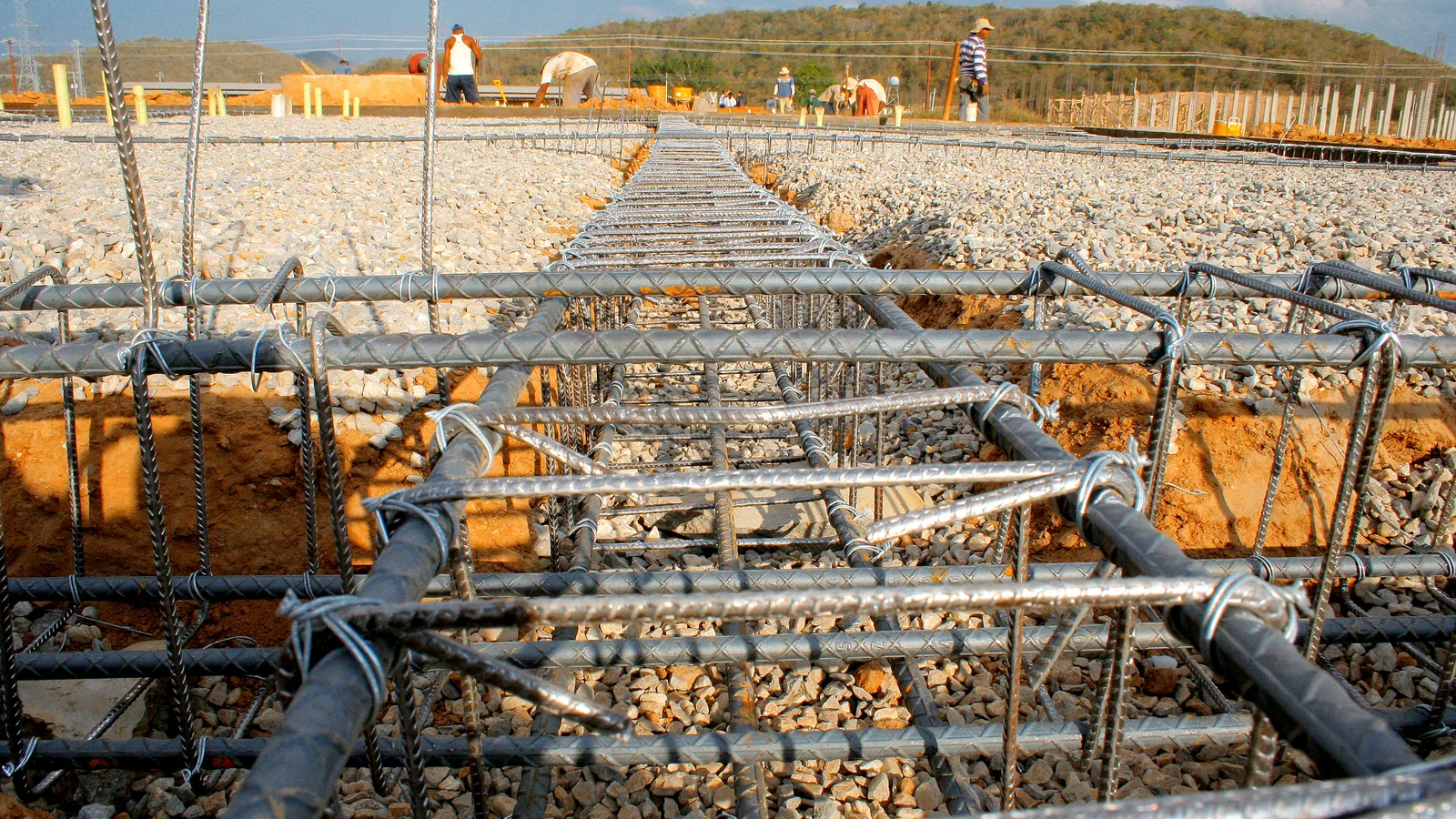
Foundation type is one of the few structural decisions that is genuinely hard to reverse. By the time the ground is open, the piling rig is booked or it is not. And it is usually decided at the stage when the least is known: a preliminary ground investigation, a massing model and a programme.
What helps is asking the questions in the right order, because one of them nearly always settles the answer before the others get a vote.
Question 1: what is the ground, and how deep is the good stuff
Everything follows from this. Not the SPT numbers on their own, but the profile: what is at founding level, what is below it, where the water table sits, and whether there is a competent layer within reach.
Three patterns cover most sites.
Competent soil near the surface. Dense sand, stiff clay or weathered rock within two or three metres. Pad footings are almost always right and almost always cheapest.
Soft near-surface layer over something competent. The decision becomes a straight comparison: dig through the soft material, or go through it with piles. The depth at which digging stops being practical is the hinge, and on many sites it is around three to four metres, below which excavation support, dewatering and spoil disposal start to dominate.
Deep soft ground with no competent layer in reach. Friction piles, a raft that floats the building, or ground improvement. This is where a geotechnical specialist earns their fee and a structural engineer should not be choosing alone.
A piece of advice that costs nothing: read the boreholes, not the summary table. The summary gives you a design parameter. The borehole log tells you whether the layer is continuous, whether there is an obstruction horizon, and whether the person who drilled it was confident.
Question 2: is it bearing capacity or settlement that governs
EN 1997-1 requires both an ultimate limit state and a serviceability limit state, and on most real sites the serviceability check is the one that sizes the foundation.
In a medium dense sand, the pressure permitted by a 25 mm settlement limit is often well below the ultimate bearing resistance divided by its partial factors. Size the footing from bearing capacity alone and the settlement check will send you back to the drawing. In soft clay the roles can reverse, and in stiff clay the long-term consolidation settlement may dominate everything despite a comfortable bearing check.
This matters for selection as well as sizing, because settlement is what pushes a scheme from pads to a raft. If differential settlement between adjacent pads is the problem, making each pad bigger is a weak remedy: a raft ties them together so the frame sees a smoother profile.
Question 3: how much of the plan area are the pads covering
This is the crude but reliable test for the pads-versus-raft decision. Size the pads approximately. If they are covering somewhere around half the building footprint, a raft is usually competitive and often cheaper, because the excavation, the blinding, the formwork edges and the setting out all stop being repeated dozens of times.
A raft also brings things that do not appear in a comparison of concrete volume:
a single, simple excavation rather than many small ones
a continuous damp-proof membrane
stiffness that redistributes load away from a soft patch
a ready-made ground floor slab
and some real disadvantages: more reinforcement to design and detail, a thicker and sometimes heat-critical pour, and much greater sensitivity to the soil stiffness assumption, since a raft is a flexible structure on a flexible medium rather than a rigid block on a spring.
Question 4: what is the structure above actually asking for
A foundation is chosen for a building, not for a soil profile. Three properties of the superstructure change the answer:
Load concentration. A shear core or a transfer column concentrates load in a way no amount of shallow footing can comfortably spread. A building can be on pads everywhere and on piles under the core.
Sensitivity to movement. A steel frame with flexible cladding will tolerate movement that would crack a masonry facade or jam a lift guide. The settlement limit is a property of the building, and agreeing it with the architect early is worth more than refining the soil model.
Uplift and lateral load. Wind on a light building, or a tall slender one, can put a pad into net tension. Shallow footings resist uplift only by their own weight plus whatever soil sits on them, which is a poor use of concrete. Tension piles are usually the better answer.
Question 5: what does the site allow
The cheapest engineering answer is sometimes not buildable.
Access. A piling rig needs headroom, a working platform and a way in. Inner-city or refurbishment sites may rule out the obvious rig.
Neighbours. Driven piles produce vibration and noise. Bored piles are quieter but slower and generate spoil. A party wall nearby can decide the whole method.
Obstructions. Old foundations, services and made ground are where piling programmes go wrong, and they are rarely fully known at tender.
Water. A high water table turns a simple excavation into a dewatering exercise, which changes the pads-versus-piles arithmetic sharply, and can raise its own flotation check on a deep raft.
A short decision path
1. Read the ground profile. If competent soil is shallow, start with pads. 2. Check settlement as well as bearing. Let the serviceability limit size the foundation if it is the one that governs. 3. Size the pads and measure their coverage. Approaching half the footprint, price a raft. 4. Look at the superstructure for concentrated load, movement sensitivity and uplift. These can override everything above, locally. 5. Test the preferred option against access, neighbours, obstructions and water before committing. 6. Write down the assumptions that the choice depends on, especially the soil stiffness and the settlement limit, so that the next person knows what would invalidate it.
The last step is the one that gets skipped. A foundation scheme is a set of assumptions as much as a set of drawings, and most of the arguments later are about assumptions nobody recorded.
Takeaways
The ground profile usually decides the answer before any other consideration gets a vote.
Serviceability, not bearing capacity, sizes most shallow foundations on granular soil.
When pads approach half the footprint, a raft is usually worth pricing.
A raft is sensitive to the soil stiffness assumption in a way that pads are not.
Concentrated load, movement sensitivity and uplift are properties of the building, and any one of them can force piles under part of a structure that is otherwise on pads.
Record the assumptions behind the choice, not just the result.
#geotechnical #foundations #eurocode7