
Rate thisNo ratings yet
Sign in to join the discussion.
Loading…
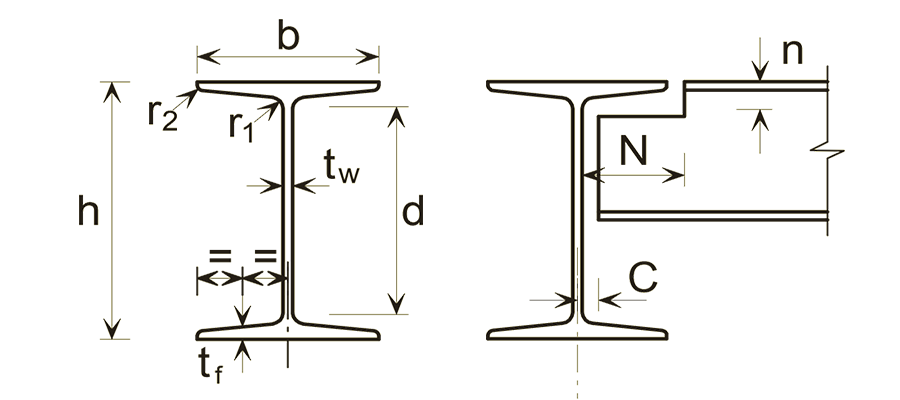
| Section Designation↕ | Mass per Metre | Dimensions | Second Moment of Area | Radius of Gyration | Elastic Modulus | Plastic Modulus | Buckling Parameter | Torsional Index | Warping Constant | Torsional Constant | Area of Section | Surface Area | ||||||||||
|---|---|---|---|---|---|---|---|---|---|---|---|---|---|---|---|---|---|---|---|---|---|---|
massi↕ | hi↕ | bi↕ | twi↕ | tfi↕ | Iyi↕ | Izi↕ | iyi↕ | izi↕ | Wel,yi↕ | Wel,zi↕ | Wpl,yi↕ | Wpl,zi↕ | ui↕ | Xi↕ | Iwi↕ | Iti↕ | Ai↕ | SA/mi↕ | SA/ti↕ | |||
| kg/m | mm | mm | mm | mm | cm⁴ | cm⁴ | cm | cm | cm³ | cm³ | cm³ | cm³ | dm⁶ | cm⁴ | cm² | m²/m | m²/t | |||||
| UJ 254×203×82 | 82.0 | 254.0 | 203.2 | 10.2 | 19.9 | 12,000 | 2,280.0 | 10.70 | 4.67 | 947.0 | 224.0 | 1,080.0 | 371.0 | 0.888 | 11.0 | 0.312 | 152.0 | 105.0 | 1.210 | 14.8 | ||
| UJ 254×114×37 | 37.2 | 254.0 | 114.3 | 7.6 | 12.8 | 5,080.0 | 269.0 | 10.40 | 2.39 | 400.0 | 47.10 | 459.0 | 79.10 | 0.884 | 18.7 | 0.039 | 25.20 | 47.3 | 0.899 | 24.2 | ||
| UJ 203×152×52 | 52.3 | 203.2 | 152.4 | 8.9 | 16.5 | 4,800.0 | 816.0 | 8.49 | 3.50 | 472.0 | 107.0 | 541.0 | 176.0 | 0.890 | 10.7 | 0.071 | 64.80 | 66.6 | 0.932 | 17.8 | ||
| UJ 152×127×37 | 37.3 | 152.4 | 127.0 | 10.4 | 13.2 | 1,820.0 | 378.0 | 6.19 | 2.82 | 239.0 | 59.60 | 279.0 | 99.80 | 0.867 | 9.3 | 0.018 | 33.90 | 47.5 | 0.737 | 19.8 | ||
| UJ 127×114×29 | 29.3 | 127.0 | 114.3 | 10.2 | 11.5 | 979.0 | 242.0 | 5.12 | 2.54 | 154.0 | 42.30 | 181.0 | 70.80 | 0.853 | 8.8 | 0.008 | 20.80 | 37.4 | 0.646 | 22.0 | ||
| UJ 127×114×27 | 26.9 | 127.0 | 114.3 | 7.4 | 11.4 | 946.0 | 236.0 | 5.26 | 2.63 | 149.0 | 41.30 | 172.0 | 68.20 | 0.868 | 9.3 | 0.008 | 16.90 | 34.2 | 0.650 | 24.2 | ||
| UJ 127×76×16 | 16.5 | 127.0 | 76.2 | 5.6 | 9.6 | 571.0 | 60.80 | 5.21 | 1.70 | 90.00 | 16.00 | 104.0 | 26.40 | 0.890 | 11.8 | 0.002 | 6.720 | 21.1 | 0.512 | 31.0 | ||
| UJ 114×114×27 | 27.1 | 114.3 | 114.3 | 9.5 | 10.7 | 736.0 | 224.0 | 4.62 | 2.55 | 129.0 | 39.20 | 151.0 | 65.80 | 0.839 | 7.9 | 0.006 | 18.90 | 34.5 | 0.618 | 22.8 | ||
| UJ 102×102×23 | 23.0 | 101.6 | 101.6 | 9.5 | 10.3 | 486.0 | 154.0 | 4.07 | 2.29 | 95.60 | 30.30 | 113.0 | 50.60 | 0.836 | 7.4 | 0.003 | 14.20 | 29.3 | 0.549 | 23.9 | ||
| UJ 102×44×7 | 7.5 | 101.6 | 44.5 | 4.3 | 6.1 | 153.0 | 7.820 | 4.01 | 0.91 | 30.10 | 3.510 | 35.40 | 6.030 | 0.872 | 14.9 | 0.000 | 1.250 | 9.5 | 0.350 | 46.6 | ||
| UJ 89×89×19 | 19.5 | 88.9 | 88.9 | 9.5 | 9.9 | 307.0 | 101.0 | 3.51 | 2.02 | 69.00 | 22.80 | 82.70 | 38.00 | 0.829 | 6.6 | 0.002 | 11.50 | 24.9 | 0.476 | 24.4 | ||
| UJ 76×76×15 | 15.0 | 76.2 | 80.0 | 8.9 | 8.4 | 172.0 | 60.90 | 3.00 | 1.78 | 45.20 | 15.20 | 54.20 | 25.80 | 0.820 | 6.4 | 0.001 | 6.830 | 19.1 | 0.419 | 27.9 | ||
| UJ 76×76×13 | 12.8 | 76.2 | 76.2 | 5.1 | 8.4 | 158.0 | 51.80 | 3.12 | 1.79 | 41.50 | 13.60 | 48.70 | 22.40 | 0.853 | 7.2 | 0.001 | 4.590 | 16.2 | 0.411 | 32.1 | ||
Dimensions and section properties for all 13 Universal Joists (UJ) to BS 4-1 (SCI P363 Blue Book): dimensions, mass and section properties for every UJ size. Sort or search the table above, and open any size for its full data sheet or an EC3 capacity check.
This page lists every Universal Joists (UJ) size to BS 4-1:2005, with the full set of section properties for each one. The table is sortable on any column and searchable by designation, and each size links to its own page with the complete property set, a worked capacity check and dimensions for detailing.
The spread is worth noticing: the heaviest UJ weighs 10.9x the lightest but carries roughly 78x the major-axis stiffness. Bending stiffness grows far faster than weight, which is the whole reason the range is shaped this way - going deeper buys stiffness much more cheaply than going heavier.
A UJ designation is serial size then mass per metre - UJ 127×76×16. The first two figures are the NOMINAL serial size in millimetres (depth × width); the last is the real mass per metre in kg/m.
The nominal size is shared across a serial group: every section in one group rolls from the same set of rolls, so the outside depth and width stay near-constant while the web and flange thicken to add mass. That is why two sections with the same first two numbers have different real depths in the table above, and why a heavier section is usually a drop-in for a lighter one in the same group.
The table above publishes 20 properties for every UJ size. These are the ones that decide a design:
Every one of these is a property of the shape alone. None of them depends on the steel grade - grade enters only when a property is multiplied by a design strength to give a capacity, which is what the Capacity tab above does.
Which property governs depends on what is being checked, and it is rarely the one people reach for first:
Open the Capacity tab above with a size selected to run these as a full EC3 check rather than comparing the raw properties by eye.